Welcome to Maid Spin, the personal website of iklone. I write about about otaku culture as well as history, philosophy and mythology.
My interests range from anime & programming to mediaevalism & navigation. Hopefully something on this site will interest you.
I'm a devotee of the late '90s / early '00s era of anime, as well as a steadfast lover of maids. My favourite anime is Mahoromatic. I also love the works of Tomino and old Gainax.
To contact me see my contact page.
 ^On board the Hinotori Express.
I left Osaka at around 10AM on the "Hinotori" Kintetsu Line. Is a fairly luxurious service which provides an alternative to the shinkansen mainline. The "Kintetsu Railroad" is in fact the largest fully private rail company in Japan, who operate completely separately from the JR network with their own rails, stock and stations. The Hinotori (Japanese for phoenix) is their flagship service which runs from Osaka Namba to Nagoya via Nara and the coast of Mie Prefecture. I've ridden the Tokaido shinkansen before between Osaka and Nagoya so I thought this would be something novel, and I highly recommend it. As well as the niceties onboard, the route is rather more scenic as you go through the ancient hills of "Yamato" in central Nara Prefecture (the birthplace of the Japanese state), and then up along the south coast for a while before crossing over the great Kiso River into the city of Nagoya.
Nagoya itself isn't somewhere I planned to visit, as I wanted to take a quick transfer here onto the Shinano Line up to Nagano Prefecture. However, arriving at the ticket gates at the Nagoya Kintetsu Station I realised I had lost my ticket somewhere on the train. I think I had just gotten used to using digital tickets or IC cards and hadn't properly put it away. But whatever happened to it it meant I couldn't get past the barriers and had to go and grovel to the "Fair Adjustments" guy. With my perfect Japanese sentence prepared I went up to his little window and asked. Luckily he have me a little ticket which allowed me out, but not before lecturing me about the importance of keeping hold of my ticket on the future and the dangers of fare-avoidance to society as a whole (at least I think that was his point). And to be honest he's right, I hate barrier-jumpers more than anyone, and for my sins I missed that connecting train into the mountains and was stuck in Nagoya for the surprisingly long time (for Japan) of 2 hours.
Making the best of a spoiled plan, I spent the time exploring a bit of Japan's third largest city. From my cultural knowledge, I'm aware Nagoya has an ambivalent reputation: not that its dangerous or dirty but rather incredibly boring. And while it might not have the endlessness of Tokyo, the prestige of Kyoto nor the personality of Osaka, I actuality liked it quite a lot. It was very pleasant, and with the exciting Japanese mundanity I've come to really appreciate. I couldn't tell you exactly where I visited, but I walked through several shoutengai, a large park with a school class practising for a festival of some kind, and ended up at a grand but quiet shrine (where I watched a wedding procession) before catching the subway back up to the main station. I'm not sure I could recommend visiting per se, but I'd say it's worth a look around if you ever end up here (and many long-distance trains do connect here). It's the Birmingham of Japan if Birmingham was all Edgbaston no Sparkhill.
Unfortunately my journey into the mountains was made mostly in the dark, and I'm sure I missed some stunning views as the train trundled is way up along the route of the old "Nakasendo" (meaning "road through the mountains", it was an alternative to the coastal "Tokaido" Road which connects Kanto to Kansai). My home for the night was in the "Grande Cabin" hotel in the south of Matsumoto City. The hotel turned out to be base camp for many hiking-types and had more of a hostel feel. I bought a ready-meal from the local Famimart and warmed it up in the communal microwave. A group of stereotypical hiking-types were sitting in the common room too and offered me a beer, which I accepted and started one of those JP-EN conversations which I'd become accustomed to now. They recommended me some mountains to climb in the area tomorrow, and warned me of the heavy snowdrifts which still stuck to the north-faces, restricting uncramponed climbers like myself to the lesser peaks: it is still February after all. As the Japanese tend to do, after what could only have been about 2 pints they started getting drunk and a group of them started to sing what I was told were "climbing songs", as I talked to another guy about mountaineering in Scotland. It was a fun impromptu evening which luckily the wakaokami didn't seem to mind, and in fact supplied us with on-the-house crisps. I was midway through trying to explain the concept of Scottish right-to-roam when the singing trio decided it was my turn and asked if England has any climbing songs. I feel like most Englishmen dread such questions, and I floundered for a minute before giving a probably terrible but at least well-received acapella rendition of "The Grand Old Duke of York", which is the only song I could think of in the moment about climbing a hill.
 ^Looking Westwards across Matsumoto-shi to the Hida Mountains.
The next morning I left the hostel bright and early to start my expedition up Mt Hachibuse, east of Matsumoto City and recommended to me last night. I was greeted by the immense geography of Nagano Prefecture which the shadow of night had hidden from me yesterday. The barrel shaped valley runs north-south with a range of truly olympian snow-capped peaks along the Western side (these are the Hida Mountains, also called the Northern Alps), and a seemingly endless expanse of highlands and further peaks away on its Eastern flank (these are the Yatsugatake Mountains, within which Mt Hachibuse rises). It's amazing that these people get to live their lives in such dramatic scenery, within sight of such raw and dangerous wilderness.
At the boundary of the city I found my trailhead, along with a set of bamboo walking poles in a box, one of which I took with me (which turned out to be incredibly important). The path quickly began to ascend into the deciduous forests, giving me a better and better view of the Matsumoto Valley everytime I turned around. Mt Hachibuse is nothing particularly special as far as Japanese mountains go, but her summit is still at over 6000ft (1800m), which far surpasses anything in the British Isles. As I crept upwards I passed through various biomes and eventually hit the snowline: at first in weak patches and then in large drifts. The temperature was mild (I was just wearing my T-shirt most of the day), but there was still plenty of snow to see. Sometimes there would be a steep part, but helpfully ropes had been anchored to tree trunks above them allowing climbers to pull themselves up, otherwise I think I would have needed crampons for these slippery sections. At one point I noticed in the snow the pawprints of many dogs, but no corresponding bootprints. I'm unsure how common wolves are here but I know they are known to patrol the mountains of central Nagano. And while I wasn't particularly worried about wolves (they're only a danger at night), I did play out a few bear scenarios in my head, none of which played in my favour. Hopefully they were all still hibernating (all hikers should remember the three bear rhyme).
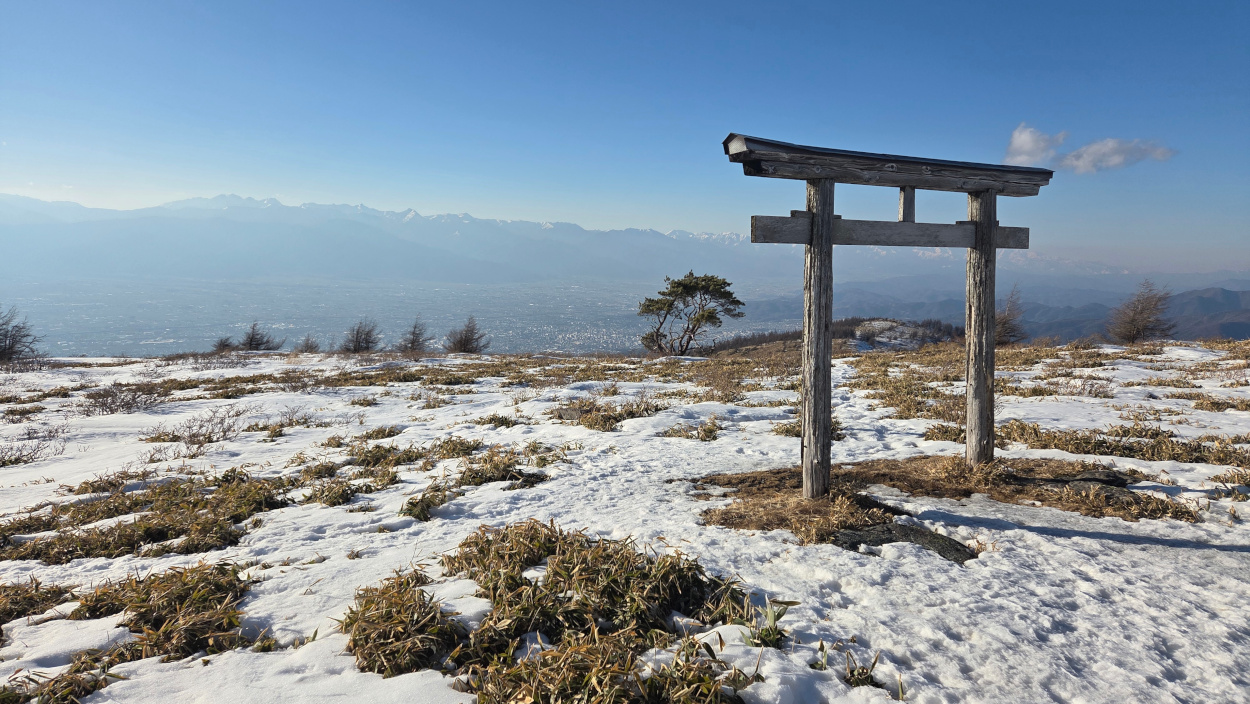
I reached the summit later than anticipated, but the view was better than I could have hoped for. The February atmosphere was thin and still, giving me a seemingly infinite range of visibility. Within my vantage I could see North into the Matsumoto Valley, and South into the Suwa valley which is my next destination. The great Suwa Lake and the peaks behind it of the Southern Alps. And far off in the distance sat the everpresent Fuji-san, a thick snowcap covering the top ⅔'s of her mass. One day I will climb Mt Fuji, I thought in that moment. A little shrine was perched on the summit plateau, which served as a court more fit for a god than any other I can imagine. The sight of the torii gate planted in the snow on this roof of the world was indeed spectacular.
My dillydallying had indeed delayed me more than I would have liked, and as I descended the sun began to dip dangerously downwards. I walked past a mountain hut as I started my own descent from which a lady emerged and gave me directions in what I assume was the local accent, but I barely made our anything. It was going well (I even saw some deer) before I made the terrible decision to take the left path at a particular fork which took me down into a gully rather than staying on the ridge of the spur like I should have done. The shadow created by the gully walls meant that far more snow remained here, which combined with the much-degraded path made the descent rather dangerous. I edged and slipped my way down the icy rocks as the grating of time's scythe began to ring in my ear. Even the beautiful mountain view betrayed me as it forced a sunset maybe an hour before that of the horizon line. By the time I reached flatter ground night had officially fallen, and I had to continue through the remaining forest in the dark. I felt a bit silly because I'd neglected some important fundamentals of hiking and my ignorance of the climate had predictably grown fangs. Luckily my trusty bamboo rod made passage over the ice flows which covered the waterways possible and I eventually wound up at the trailhead car park. A concerned man asked me if I needed a ride but I declined in a thoroughly British manner, now past any real danger after all. A few minutes later I passed an old man, or at least the shadow of an old man, his small body hunched over unnaturally as he slowly plodded down my same path. "Konbanwa. Daijoubu desuka?" I asked in some forced Japanese. The man made absolutely no response and just stared at me, or at least I think he did for I couldn't make out his face. "Nanika otetsudau desuka?" I asked. The grammar is probably wrong but I'm sure it was understandable, but neertheless I heard no response, so I just said goodbye and carried on through the darkness of the woods, checking behind me at intervals until he disappeared into the dark...
Soon the glowing lights of a 7-Eleven petrol station greeted me as I left the darkness of the trees and returned to the land of the living. The rest of the walk down to the train station was agonisingly protracted, but I eventually caught the train back into Matsumoto and collapsed into my bed, exhausted. Tomorrow it is on to Suwa, which is a special place I world like to provide a more standalone introduction to, so I will leave that until next week.