Welcome to Maid Spin, the personal website of iklone. I write about about otaku culture as well as history, philosophy and mythology.
My interests range from anime & programming to mediaevalism & navigation. Hopefully something on this site will interest you.
I'm a devotee of the late '90s / early '00s era of anime, as well as a steadfast lover of maids. My favourite anime is Mahoromatic. I also love the works of Tomino and old Gainax.
To contact me see my contact page.
Tastes shift with the generations; following cyclical (or more exactly sinusoidal) trendlines, a wide variety of cultural forces wax and wane in surprisingly clockwork periods. Clothing, hairstyles, baby-names, slangwords; these obvious "signs of the times" oscillate in and out of the vogue like a stone halfway up the beach in the tide. There are many factors at play here: indeed as many factors as there are people, but several trends can be observed. Nostalgia plays a huge part: the helmsmen of the cultural zeitgeist are those of around 30, and so often stuff from around 20 years prior will suddenly come back into the limelight: currently this is the '00s, while the aesthetics of the '90s have taken a PR freefall in the last several years. Some things have longer periods: baby-names is one that is easy to track; these usually skip generations, with parents naming their children after the recently deceased grandparents, while avoiding names from their parents generations because they "sound too old". We can now start to build up the resultant phenomenon of the "echo". If the current generation elevates the names of two generations prior, then it stands to reason that that generation originally did likewise, creating the aforementioned sine-wave. Say some great man called "John" appeared hundreds of years ago, it would stand to reason then that it would kick-start a John-wave which, through the independent actions of many millions of individuals, would echo back-and-forth through the centuries eventually being confused by the differences of length in the generations and future important "Johns" which will introduce new high-nodes. Many of these new great-Johns will in fact be named because of the original John, making those they influence the echoes of echoes.
We also see the rise and fall of generations in specific aspects of their collective soul. The famous "strong men create good times" quote assumes a static definition of "strong" and "good", and while I think it can be satisfactorily argued for the latter, the former far less so: "personal strength" very subjective to the requirements of the age. We can link this in with childhood-nostalgia. The paragons of strength we are exposed to as a child will define that for ourselves, we hold the heroes of our youth in reverence. However because of the strange loop of nostalgia, these people will naturally fade away, putting every generation in the position of being the "weak men" created by "good times", or more exactly it seems the romantic like to place themselves perpetually on the boundary where the "weak men" are forced to become "strong men" by the "hard times". I see this sentiment in (masculine) poetic works stretching back to the classics. However it would be unfair to dismiss the sinusoidal nature as an illusion. Cultures have ups and downs in repeating patterns which can be tracked by history. The English Race have fortunes which can be mapped nicely onto a sine-wave with a period of around 300years beginning at their ethnogenesis somewhere in the 5th/6th centuries. I'll add a little chart to the footnotes illustrating this. Similar patterns are evident across most civilisations, the general trends of which seemingly near-impossible to break except in the case of wholesale civilisation apocalypse like in the case of the colonisation of the New World.
This "flat circle" view of time is appealing, but must be paired with the evident linear changes of the world. Many global trends instead seem to follow linear patterns, even across many thousands of years. World population, technological and philosophical advancement (or at least the literary accumulation thereof). These trends can instead be viewed as part of "the world story", the definition of which would involve a solution to the meaning of life itself and is therefore outside the remit of this post. But to simplify, the dialectic between the "positive correlators" and the "negative correlators" is one as old as history exemplified by today's left-right political split, and yesterday's science-religion split. But some principles of calculus should be remembered. A view of a tiny portion of a sinusoid can look like linear. A larger portion can look exponential or logarithmic. An even larger portion can look like a paraboloid or sigmoid. Take recent world-population statistics. The consensus I grew up with was one of never-ending exponentialism, which morphed into a sigmoidal outlook by the time I finished school, and now it's looking like it may well be gaussian. Next step sinusoidal?
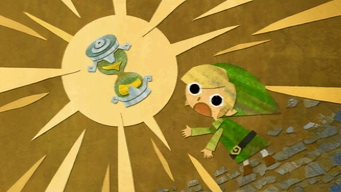
From my outsider perspective it seems like the oriental religions believe this extrapolation of linear trends to be sines is universally true. The neverending loop of death & rebirth which sees souls follow a wave-pattern of enlightenment. Even a trend which has been linear for the entirety of recorded history is really just an incredibly-long-period loop. The Buddha's innovation was to escape this trend and enter a static node above the flat circle, which seemingly breaks the world-view, however with the neverending loop of time carrying on beneath his heaven, the cosmological model is still distinct from a true eschatology seen west of the Indus; I'd say it is more like a toroidal world, one where the major and minor radii are equal creating a point in the centre rather than a hole. It is within this singularity that the Buddha sits. Christian cosmology is incredibly varied. Again appears the concept of one static singularity, however this is one from which all other emanate. As the toroid spins the singularity stays static, however this is no longer a measure of "time" but of a celestial "spacetime" with God in the centre and an increasingly fast multi-dimensional plane extending out vertically from the centre and curving away, something like a catenoid. I don't really have the words to describe this shape, and I don't have the time to attempt to build a model of it; any model would be incomplete anyway without describing the many-dimensional nature of the flat planes. But I suppose it would look something like an hourglass, which I suppose would be fitting.
That's all I have, thanks for reading my ramble.
| ~350 | ▲ Anglosaxon settlement of Britain |
| ~500 | ▼ Intersaxon wars & King Arthur |
| ~600 | ▲ Heptarchy & Christianisation |
| ~750 | ▼ Viking Subjugations |
| ~900 | ▲ Unification of England |
| ~1100 | ▼ Norman Invasion & the Anarchy |
| ~1300 | ▲ Edwardian conquests of Scotland, Wales & France |
| ~1425 | ▼ Loss of France & War of the Roses |
| ~1550 | ▲ English Renaissance & Elizabethan Golden Age |
| ~1700 | ▼ Sectarianism: Civil War & Jacobite Uprisings |
| ~1850 | ▲ Industrial Revolution & Empire |
| ~2000 | ▼ Modern postcolonial decline |