Welcome to Maid Spin, the personal website of iklone. I write about about otaku culture as well as history, philosophy and mythology.
My interests range from anime & programming to mediaevalism & navigation. Hopefully something on this site will interest you.
I'm a devotee of the late '90s / early '00s era of anime, as well as a steadfast lover of maids. My favourite anime is Mahoromatic. I also love the works of Tomino and old Gainax.
To contact me see my contact page.
Nestled deep in the mountains of central Japan lies an enchanted lake. An ancient town huddles up next to its shores, in the strip of flat land between the icy waters and the impenetrable forests of the Japanese wilderness beyond. The valley is hemmed in on three sides by mountains: the line of snow-capped ridges in the West mark the grand skyline of the Japanese Alps, the imposing volcanic cone of Mt Aka looms in the East, and in the North the comparatively lower hills of the Shioriji Pass, a vital mountain route linking Matsumoto-shi to Yamanashi. The only flatter terrain lies southwards, along the narrow valley which stretches nearly 100 miles as far as the eye can see: a straight corridor the vanishing point of which is punctuated by that almighty mountain of Japan: Fuji herself. For many centuries this area has been an important staging post for travellers: a gateway for the coastal cities of the South to access the inner province of Shinano (now Nagano), or for the odd renegade daimyo to blockade and hole himself up in nature's fortress. On a map the lake of Suwa ("Suwako" or 諏訪湖 in Japanese) stands out once you know where to look: the only major body of water in Chuubu it sits slap-bang in the centre of the land-mass of Honshu. Traditionally it has been known as the "naval of Japan", and I can see why. The lake itself is vast, several miles in diametre (although its limits apparently used to be quite a bit wider before land reclamation), and the uncountable number of small streams that feed it are famous for their purity and healing properties. Some run ice-cold, some run close to boiling point. The largest actually runs into a huge aquifer underneath the lake, and erupts up into it from below causing strange visual effects on the surface and even a geyser on the eastern bank. Like the local snow-macaques, the Japanese have of course jumped on these waters, building a plethora of bath-houses which line the shores of Suwako like some sort of heavy industry: in the evening steady lines of steam can be seen pumping out from each of their chimney stacks, sitting like herons around a pond.
This geographical centrality and natural beauty attracted worship from the Japanese spiritualists of yore, with Suwa becoming a centre for early Shinto. The "Suwa Grand Shrine" (諏訪 大社) as it is known today was founded sometime in the early 7th century, supplanting even older traditions in the region, and has existed much unchanged ever since. The Touhou Project game series takes a lot of inspiration from the area, with many of the characters (and the whole of Mountain of Faith) being taken from the local legends, which gave me a beginner-level understanding of some of the concepts of the area, but nothing very deep. The grand shrine complex itself is actually split into four shrines across two sites. I visited all four on my visit (and a secret fifth one). I think they are some of the most interesting places I've ever visited, and I'll describe them to you here.
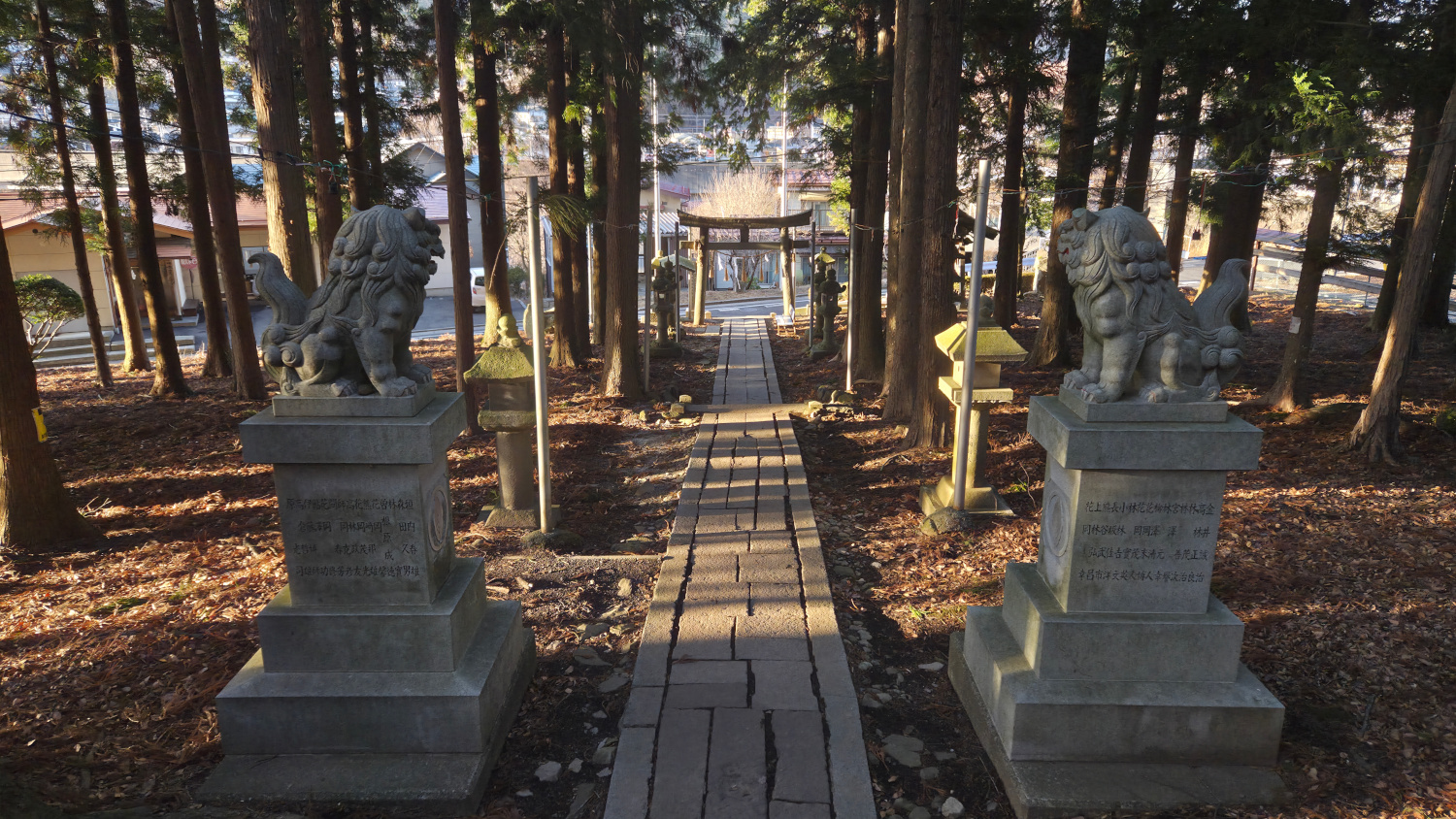
In the South are the two "Upper Shrines" (上社), these house the "Great Kami of Suwa": "Takeminakata". The "Maemiya Shrine" (前宮) sits at the foot of Mt Moriya, and although it is the smallest of the four, it is the oldest. It has the most conventional structure of the four in a style seen across Japan. The "Honden" (main hall) sits at the rear and houses the "body and spirit of the kami"; it is strictly off limits to laymen and its interior is a mystery. In front of the honden is the "haiden" (worship hall), where visitors can give offerings and make prayers. In front of that will be a series of outer buildings like the priest's office (for selling amulets), performance hall (for miko riutuals), or hand-washing station, and usually a grand stairway entrance surmounted with a torii gate. Maemiya is most famous for being the centre of Suwa's most infamous festival called "Onbashira". The festival only occurs once every six years, and involves teams of local men hiking up into the forests of Mt Moriya, picking out the best fir trees to fell, and then constructing harnesses around them and racing them like giant sleds down the mountain in an incredibly dangerous sport which has recorded fatalities nearly every time it comes around. It is apparently a rite-of-passage for the young men of the area, being expected they will participate at least once. You can watch a clip of it here, it puts England's cheese-rolling festival to shame. The next Onbashira Festival will be in Summer 2028; continuing a tradition that is potentially older than the Japanese people themselves according to the museum, which says it was probably originally a Jomon ritual (the people group who lived in Eastern Japan before the Yamato moved in during the 1st millennia). These logs (called onbashira themselves) are sanctified by the head priest are then parading across the lake and distributed to the four shrines as "border pillars"; that is one is erected vertically at the four corners of each shrine to act as "boundary posts" to the sanctified land.
The "Honmiya Shrine" (本宮) is a mile north of Maemiya, and is the most important shrine of Suwa Taisha as it is the principle home of the Great God. It is a sprawling and unconventional complex of wooden walkways and several sub-shrines. While I was there many families were visiting, taking it in turn to carry out some type of purification ritual with a priest on the main stage. Controversially the Suwa Taisha priesthood maintains that the head-priest of Honmiya (a position which has been passed down patrilineally since its inception) is a "arahitogami", that is, descended from Takeminakata-kami himself and thus are themselves "living gods", the only person in Japan who claims this heritage besides the Emperor himself, and even that is itself controversial. I am not versed in Shinto theology to an extent where I can comment on specifics, but it seems the priests of Suwa have a somewhat different (and generally more conservative) outlook on cosmology than standard "state Shinto". Being the central shrine Honmiya naturally had the most visitors, although pretty much exclusively domestic tourists. Outside the shrine was a market street selling a wide range of trinkets and "omiyage" that they are so obsessed about here. I don't really care for that sort of thing, but I was introduced to the mascot-character "Suwahime" here. She is the princess of Suwa-Castle and has served as the "moe mascot" of the area for over a decade now: if you look you will find her in all sorts of places including the official tour-guide app (which is pretty useful). She is very cute (I did buy a little souvenir of her).
Next are the "Lower Shrines" (下社) to the North of Suwako, being the Spring Shrine Harumiya (春宮), and the Autumn Shrine Akimiya (秋宮). These two house the she-kami "Yasakatome", who is the wife of the Great Kami, and whose presence is ceremonially moved between the two twice a year. To get there I took the local train from Kamisuwa Stn down to Shimosuwa Stn, which puts you very close to Akimiya. This shrine is very different from the previous two. It is a square structure again bounded by onbashira, but central is a Performance Hall, from which miko perform ceremonies including dances and acts of purification. The shrine itself is behind this structure and almost secondary, which is apparently common in the shrines of female kami. Here a hot spring erupts within the shrine grounds, and so hot water can be bottled and taken as a trinket, or used to wash your hands. I liked Akimiya a lot, it had a quieter atmosphere and seemed busy with miko going about their business. Here there is also a holy cedar tree which is the shrine's "holy object", just as Mt Moriya was for the Upper Shrines. At all the shrines you will find wooden boards inscribed with the prayers of visitors called "ema" (絵馬), but here there were a lot more for reasons I am unsure of. Many of them were "ita-ema" depicting characters from various Touhou games, so I duly bought my own and added it to that section.
Harumiya was much the same as Akimiya, with the central Performance Hall and secondary buildings surrounding it, although on a slightly smaller scale. Like Akimiya Harumiya also has a holy tree, this one being a yew. Probably the most famous thing here is the stone monk, carved from a boulder found on the site which apparently bleeds when struck with a hammer.
Visiting the four shrines is pretty tiring, but is the traditional day out in Suwa for visitors here. You really start to understand the place when you see the centrality of this institution. It seems everything revolves around the calender of religion here, in tune as it is with the seasonal climate. The more you dig the more interesting legends and tales you will hear, such as the "God's Path" visible across the surface of Suwako whenever it freezes over, or indeed the Enrei-Onodachi Festival held twice a year and known as the "shortest festival in Japan" lasting between 10 and 30 seconds. However, as the sun was setting I went out to try and experience a bit of the most intriguing story I heard during my shrine visits, one that was seemingly vitally important but obscured in the general view of people here.
Tucked away in the Northwest bank of Suwako, in the shade of the northern foot of Mt Moriya sits the eponymous Moriya Shrine. It's small but perfectly kept by a small, ageing but diligent parish (a few of which were around when I visited, cleaning things up and doing some garden-work. Here is enshrined the kami "Moriya", who is older and more powerful than any of the kami of Suwa, according to the locals. Nothing is really known about Moriya-kami, not even his/her gender, but it is said that Moriya-kami was the original Grand Kami of Suwa, supplanted by Takeminakata-kami when he first arrived in the valley (potentially in allegory with the arm of the emerging Japanese State centred in Kansai). There is evidence of Moriya worship from as early as the 4th century, with artefacts pointing to Moriya being some sort of snake deity who became a travelling hunter living amongst humans after his ousting. Small shrines to Moriya-kami can still be found littered across the valley, and especially as you climb into the upper reaches of Mt Moriya itself. An amazing continuity of tradition. Moriya Shrine was a truly special little place: you can feel all those millenia of history on top of it and underneath it; fallen from honour but kept going all these centuries later by a tiny group of villagers whose legacy extends so many generations into the past. And that's really why I loved my time in the valleys of Nagano so much, their seclusion has bred a fractal explosion of traditions so complex that each stream, each hillock has its own name and story developed over indeterminate amounts of time.
After a long, long day of walking and thinking, I arrived at my not-so-little ryokan for the night. Like the bathhouse of Spirited Away, the chimneys huffed & puffed away as the yukata-clad patrons roamed the long halls between the rooms and baths. The lights of Suwa flickered on as the sun set across the lake, and I spent the next two hours trying each and every bath-type the many bathing halls of my ryokan had to offer. The boiling-hot joy-spring water, the sulphuric black-rock water, the dubious sounding "zero magnetic field" water, even a bath infused with locally brewed sake which got you a bit drunk as you sat in it. And as I silently sat in the steaming water under the emerging stars of the February sky, I wondered whether the kami too enjoyed such human but universal joys. I looked around to my anonymous companions bathing with me, and wondered whether if any one of them could in fact be Moriya-kami themselves. I don't think I would have been that surprised.