Welcome to Maid Spin, the personal website of iklone. I write about about otaku culture as well as history, philosophy and mythology.
My interests range from anime & programming to mediaevalism & navigation. Hopefully something on this site will interest you.
I'm a devotee of the late '90s / early '00s era of anime, as well as a steadfast lover of maids. My favourite anime is Mahoromatic. I also love the works of Tomino and old Gainax.
To contact me see my contact page.
The past is down, the future is up. This synaesthetic relation is sensible. Due to Earth's gravity well all objects want to go down, with global entropy firmly facing downwards. The progression of time is inversely upward moving. Imagine a timeline-meter stretching out vertically forever, marked with every time with the Earth's surface acting as an arrow indicating the current time. This meter moves steadily downwards at a rate of "one second per second", or potentially the world moves up the meter at the same rate it's hard to say. Each moment of the past is represented by a layer somewhere beneath our feet obscured by soil and rock; each moment of the future is represented by a layer somewhere above us, unreachable until its time comes.
The job of an archaeologist is to dig down through these layers of time into history and investigate their contents. Geologists have a similar technique, as do climatologists and palaeontologists. Basically any study of the past requires digging a hole into the Earth to study her insides. And while the future cannot be "studied" as such, almost everything new will be directionally upwards: we build new houses upon the remains of the past in a never ending layer-cake.
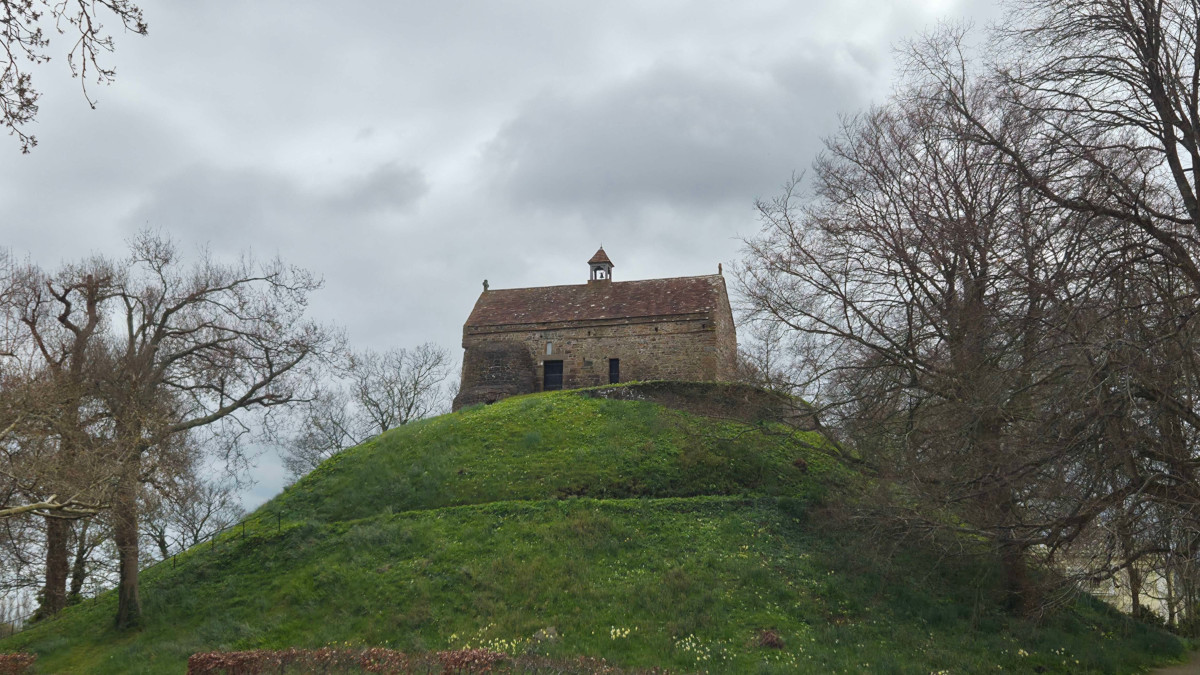
I like places where this structure is clearly visible. Recently I visited the site of "Hoogue Bie" on the island of Jersey. The site is an ancient earthen mound which has been in some form of human-use for around 6,000 years, making it one of the oldest human structures in the world. The area is built on top of a natural freshwater spring, which was assumedly the initial attraction for people to the spot; a wishing well still sits at the base which you can use to pay your dues before exploring. Above the wellspring Neolithic-Man built built a barrow, as he is oft known to do. This is one of the best preserved barrows of the region known (by the French) as "La Mancheland", which is the now submerged valley of the great river which once carved out the English Channel. You can even climb into the barrow itself and get about twenty metres inside, where rows of cubby-holes can be seen dug into the walls that used to contain the bodies of our early ancestors (they were apparently looted before even the Victorian antiquarians got to them). Then, in stages over thousands of years it seems, earth was piled up on top of the barrow, containing some later burials but also random artefacts including a massive hoard of 70,000 Celtic and Roman coins from around the time of Caesar's invasion of Gaul, assumedly hidden there by retreating Gaulish princes to keep them from the grasps of the legions. A myth of unknown age holds that a local hero fought and slayed a dragon atop the mound, but was murdered by his servant soon after and buried within the mound.
It seems that after Roman Conquest the site lay unused for some centuries. By this point it had been built up into one of the highest points on Jersey and thus a good spot for looking out across the central fields of the island. There is some evidence of a wooden tower being constructed atop it for this reason. Then in the 12th century things changed for the island. The major part of the Duchy of Normandy, which the Channel Islands were governed under, was taken from the English king by the emerging French crown leading to hundreds of years of on-and-off wars between the two states. Jersey was the closest island to the European mainland under English control, and so increased attention (and money) flowed into her harbours. With some of this wealth a chapel was built on top of the Hoogue dedicated to "Our Lady of Clarte", a Breton saint. In the 16th century (during the pilgrimage boom) the chapel was expanded with a belltower and a curious crypt. The crypt was built into the top level of the hill, and meant to reflect the structure of the Holy Sepulchre with an empty tomb accessed through a trapdoor under the altar.
This was the last permanent addition to the hill but not the last attempt. The heir to a spurned French nobleman who fled to England after the Revolution built a large black neogothic tower around the eastern end, which was by all accounts in bad taste and was demolished in the early 20th century when the site came into public ownership. During WWII the Channel Islands became the only land in the British Isles to be captured by the Germans, who heavily fortified the island with concrete abominations. This included a watchtower strapped like scaffolding to the chapel's belltower, an addition which was removed shortly after D-Day.
 ^ A photo I took showing the exposed entrance to the barrow below and the chapel of La Hoogue Bie above.
As you can see from my photo, this layered history is visually present in a very pleasing way. Each stage of civilisation placing their monument atop the other to prove their truth has triumphed over that truth which came before, all while respecting the obvious universal sanctity of the location. Somewhere which was already a place chosen by the environment to be special (the wellspring), became a resting place for the heroes of prechristian society, slowly building up on top of their forefathers. Then the church placed herself on top of it all, as if to imply a finality to this issue. You can't exactly build anything on top of a church, so this punctuation mark of a building has a powerful symbolism. Even within the chapel itself a more intellectual depiction of this "pile of history" can be seen, with the sepulchre placing the "grave of Christ" as the highest and final grave of the barrow. Even the attempts at later additions follow this trend. The great follies of the modern era who place themselves above God. The chintzy tower represents the idolatry of the romantic era, and the Nazi watchtower represents the failure of the Nietzschean "ubermensch" to supplant us. Nowadays we are of course far too timid to impose ourselves on such relics of history, although I did note the copper lightning rod affixed to the belltower: I suppose it is a very human need to meddle.
But the Hoogue Bie is just a fortuitously clear example. Every step you take is above a myriad layers of history: every field, every road, and especially every town. In the ruins of Troy archaeologists have dug down to find evidence of 12 separate towns all built on top of each other over a period of 4000 years, with the Troy of Homeric fame being one of the more recent iterations (3rd down). I think it is important we respect these invisible histories which we can never really understand: maybe in its day the tenth Troy down was just as mythically charged as the Troy of King Priam is for us. Like at Hoogue Bie we can respect these monuments to humanity without having the context, but equally without lionising them above what we understand to be true and good.